
Proximity Targeting: The First Test of Accountable AI

What should TV advertisers actually trust AI to do?
AI now builds audiences, configures campaigns and recommends where budgets should move. The harder part is knowing which of those jobs to hand over. CIMM’s recent Innovation Showcase paper on AI in TV advertising, which features Blockgraph, recommends a principle it calls accountable automation: let AI make decisions only where it clearly improves a defined outcome, with controls that match what is at stake. Download the CIMM report
If accountable AI has to start somewhere, we think it should start with proximity targeting.
Four tests for accountable AI
A responsible first use case for AI should pass four tests. Many AI applications in TV struggle to meet them all. Proximity targeting passes all four.
A clear objective. Many audiences begin with an abstraction, such as a modeled persona or an intent score. Proximity targeting begins with a business fact: where the stores, clinics, dealerships and branches are. The goal follows naturally: reach the households closest to those locations, because the closest households are typically the most valuable to the business. The business sets the objective, and AI executes it.
Inputs anyone can inspect. An audience built with proximity targeting can be explained in one sentence: these locations, this radius, this many households. Anyone from a planner to a CFO can review the logic and judge whether it makes sense. If a radius proves too tight or a location closes, the marketer adjusts it. AI does the heavy lifting, and people keep control.
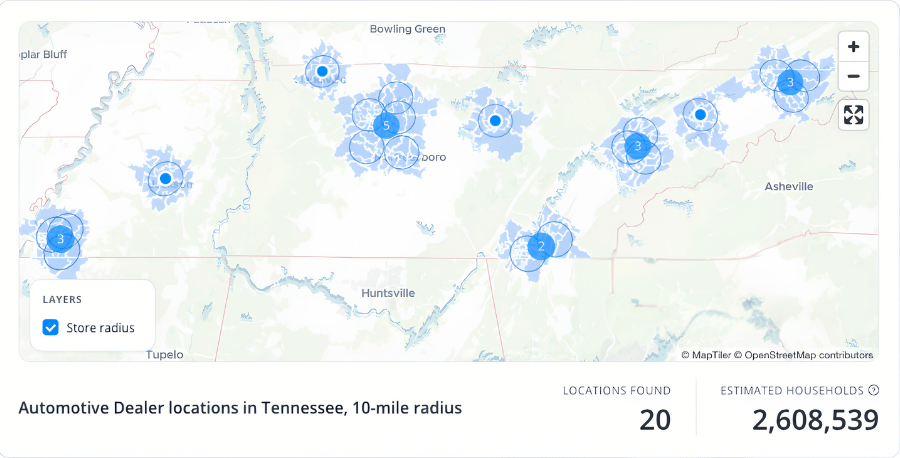
(Source: Blockgraph Proximity Targeting)
A signal tied to revenue. Automated systems tend to chase what is easiest to measure, like cost and impressions. Proximity targeting keeps the focus on the trade area where sales actually happen. The radius can fit the category, too: a few miles for quick service, much farther for an airport or a hospital system.
A result you can measure. Households near a store were always more likely to visit, whether or not they saw an ad. So comparing exposed nearby households with unexposed households farther away will make any campaign look better than it really is.
But geography also supplies the fix. Run the campaign around some locations and hold back comparable ones, and the difference in results shows what the ad actually did. The standard is lift over a credible baseline.
Identity is what makes it work
Each of these tests depends on connecting locations to the households around them, and those households to the TV exposures they receive. Get that right, and every other advantage follows.
It is also what lets speed pay off. AI can turn thousands of locations into audiences in minutes, and accurate, current household data keeps those audiences true to the locations and radius the marketer chose. That is why Blockgraph’s household identity foundation is the anchor, and proximity targeting is where it goes to work.
Where to start
Moving fast with AI and staying in control are not opposites. Proximity targeting proves both are possible: a clear goal, visible inputs, a signal tied to revenue and a result you can test. For agencies and marketers looking for a smart first step with AI in TV, it is the place to start.
Read the full CIMM report.
Talk to us about proximity targeting for your next TV campaign.
You Might Also Like
2025: Full Speed Ahead for the New TV Industry
Explore emerging trends that will reshape TV ad tech and redefine roles across the marketplace.

2023 Predictions
“The purpose of thinking about the future is not to predict it but to raise people’s hopes." -Freeman Dyson

2022 Predictions Recap
2022 feels like a significant year.